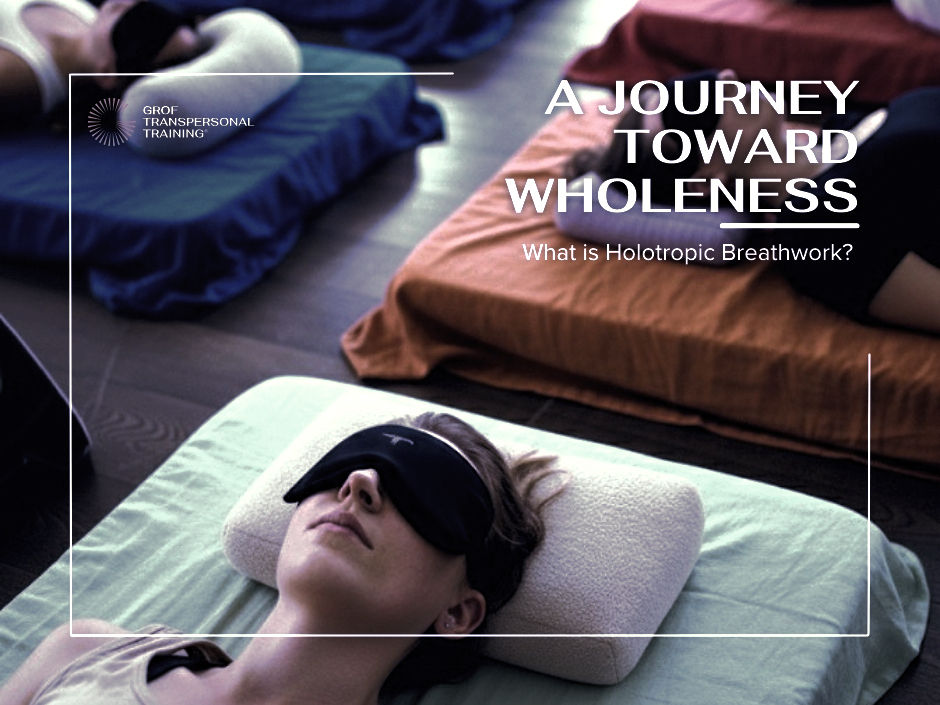
Turning Within: What happens during a Holotropic Breathwork Session?

Updated: May 8
At a certain moment in the session, something subtle begins to shift.
The attention that is usually directed outward, toward the world of tasks, roles, and expectations, slowly turns inward.

The breath becomes the guide. The music becomes a river carrying the psyche deeper. The body, often silent in everyday life, begins to speak in its own language.
What unfolds in a Holotropic Breathwork session is not something that can be predicted or directed. Each person enters an inner landscape as unique as their own life. Yet again and again, certain territories appear—fields of experience that have been carefully mapped in Stanislav Grof’s cartography of the psyche.
What follows is not a linear journey, but a movement through different layers of the human soul.
The Body Remembers

Often the first doorway is the body.
As the breathing deepens, sensations may intensify. Tingling in the hands or face. Waves of warmth or cold. Trembling. Spontaneous movements. Muscles contracting or releasing in unexpected ways. The body may curl, stretch, shake, or rest in stillness.
Sometimes there is a sense that the body is unwinding something long held, tensions stored in tissues, gestures never completed, impulses that were once suppressed.
Participants often describe the experience as if an ancient intelligence within the body has taken over the process. Instead of being directed by the mind, the body begins to guide the journey. Breath becomes wind moving through an inner landscape, loosening old knots and opening forgotten pathways.
What surfaces may feel physical, yet it often carries emotional meaning. The body and psyche reveal themselves as two expressions of the same deeper movement.
The Biographical Landscape
As the journey unfolds, memories may arise.
Not necessarily as simple recollections, but as vivid re-experiences. A moment from childhood. The atmosphere of a family home. The feeling of being seen, or not seen. Forgotten joys. Long-buried grief. Anger that once had no voice.
These experiences may emerge with surprising clarity. A smell, a gesture, a tone of voice. The psyche seems to move toward unfinished emotional stories, inviting them to be felt fully this time.
Tears may come like rain that has waited years to fall. Laughter may burst forth unexpectedly. Sometimes participants relive moments of profound tenderness or love that shaped their lives in quiet ways.
In these moments, the past is not simply remembered, it is metabolized. The psyche completes movements that once remained incomplete.
It is as if the inner world is gently reorganizing itself.
Constellations of Memory: COEX Systems
Sometimes experiences do not appear as isolated memories, but as a whole constellation of related feelings and situations. Stanislav Grof called these COEX systems: systems of condensed experience.
A COEX system links together different moments from a person’s life that share the same emotional tone. A feeling of rejection in adulthood may suddenly connect with a childhood memory of exclusion. That childhood memory may, in turn, resonate with even deeper layers of experience such as being left alone after birth or the parents not being sure if they wanted the child. Or transgenerational patterns such as a grand parent being left by the mother and given over for adoption.
During a session, these constellations can unfold like a thread running through time. Participants may move through several scenes from different periods of life, yet all of them carry the same emotional core.
When the deepest layer of such a system is reached and fully experienced, something remarkable can happen: the entire network of memories may begin to release its charge. What once felt like a repeating pattern in life can soften or transform.
It is as if the psyche has found the root of a long-standing story and gently untangled it.
The Perinatal Depths
For some participants, the journey moves even deeper into layers connected to the very beginning of life.
Experiences may emerge that carry a sense of primal intensity, feelings of pressure, struggle, confinement, or powerful waves of energy. Participants sometimes describe sensations of being squeezed, pushed, or moving through a narrow passage.
Others encounter vast emotions that seem larger than personal biography: existential fear, overwhelming despair, fierce determination, or explosive liberation.
In Grof’s model, these experiences are connected to what he called the perinatal domain, the psychological and somatic imprint of the birth process.
Here the psyche encounters archetypal themes of death and rebirth.
At this level, the body may seem to remember something older than memory. The experience can echo the original drama of human birth: the long containment in the womb, the increasing pressure as contractions begin, the struggle through the birth canal, and finally the moment when darkness breaks open into light and breath.
Participants sometimes describe the sense of being caught in an overwhelming process, pressed by forces larger than themselves, unable to escape, pushed toward a transformation that cannot be avoided. At the deepest point, the experience may resemble a symbolic death: the collapse of control, the dissolution of familiar identity, the feeling of reaching the limit of what one can endure.
Yet within the same movement lies the impulse toward emergence.
Darkness may suddenly give way to light. Constriction may transform into expansion. A moment of total surrender may open into an immense sense of release, relief, or triumph—as if the organism has passed through an ancient gateway and arrived on the other side of life.
Many participants describe these passages as encounters with the fundamental forces of existence—destruction and creation, collapse and renewal.
In this sense, the birth experience becomes more than a biological event. It reveals a deeper pattern that continues to shape the rhythm of human life.
Again and again we move through similar thresholds: the end of relationships, the loss of old identities, moments of crisis or profound change. Something in us must let go, dissolve, or die so that something new can emerge. These passages often feel uncertain or painful while we are inside them, yet they are also the gateways through which growth becomes possible.
The perinatal realm reminds us that we are cyclical beings. Life unfolds not as a straight line, but as a series of endings and beginnings, contractions and expansions, descents and emergences.
To move through such an experience in a session can leave a deep imprint: the embodied knowing that even in the darkest contraction, the movement toward birth is already present.
Emerging from these depths often carries the feeling of having crossed an inner threshold—of having touched a primordial rhythm that connects personal life with the larger cycles of existence.
The Transpersonal Horizon
Beyond personal memory and birth-related experience lies an even wider territory.
Sometimes the boundaries of the individual self soften. The sense of identity may expand beyond the usual story of “me.”
A person may feel deeply connected to nature, as if breathing with the forest, the ocean, or the earth itself. Others encounter symbolic imagery, mythic landscapes, or archetypal figures.
Some report experiences of becoming an animal, a river, or a star-filled sky. Others encounter ancestral presences or collective human emotions that seem to belong to the larger story of humanity.
Moments of profound unity may arise, states in which the usual separation between self and world dissolves into a feeling of deep interconnectedness.
These experiences belong to what Grof described as the transpersonal realm of the psyche.
Here the inner journey touches dimensions that many spiritual traditions have described for centuries: the sense that consciousness is larger than the individual personality.
For some, these moments bring awe. For others, deep peace. For many, a renewed sense of meaning.
Challenging Experiences in Holotropic Breathwork Sessions
Not every moment in a Holotropic Breathwork session is easy.
At times participants encounter powerful emotions—fear, grief, anger, or deep vulnerability. Old wounds may surface. The body may move through intense sensations. The psyche may enter territories that feel unfamiliar or overwhelming.
From the outside, such moments might appear difficult. Yet within the holotropic framework they are often understood as meaningful stages of a healing process.
The psyche tends to bring forward exactly the material that is ready to emerge and be integrated. What surfaces during a session is rarely random, it is usually connected to unfinished experiences that are asking to be seen, felt, and completed.
With the support of the facilitators, the safety of the setting, and the trust in the inner process, participants can move through these challenging passages.
And often, on the other side of the intensity, something shifts.
Fear may transform into strength. Grief may open into compassion. Anger may reveal long-suppressed vitality. What initially felt like a crisis can become a doorway.
In this sense, even the most challenging experiences can be deeply beneficial. They are part of the psyche’s natural movement toward wholeness.
Insights and Inner Knowing
Not all insights come as thoughts.
Sometimes understanding arrives as a felt knowing in the body. A sudden clarity about a life pattern. A quiet realization about a relationship. A sense of forgiveness that emerges without effort.
Images, symbols, or simple bodily gestures may carry messages that the rational mind only later begins to understand. Participants often describe the experience as if an inner healer—or an inner intelligence, were guiding the process.
Rather than being imposed from the outside, the movement toward healing arises from within.
Returning
Eventually the music softens. The breath slows. The body settles.
Participants often lie quietly for some time, allowing the experience to integrate. Afterwards they may express aspects of their journey through drawing, movement, or sharing in the group.
What remains is rarely just a memory of an unusual experience.
More often it is a subtle shift: a feeling of having touched something authentic and alive within themselves. A renewed connection with the body. A deeper trust in the psyche’s capacity to heal and transform.
The Inner Landscape and Holotropic Breathwork

A Holotropic Breathwork session is not a technique that produces a specific result.
It is an invitation.
An invitation to turn inward. To listen to the body, meet the forgotten, the unfinished, the mysterious.
Within each person lies a vast landscape, personal, ancestral, and universal at once.
Holotropic Breathwork simply opens the gate.
And when we step through it, we may discover that the psyche is far larger, wiser, and more creative than we ever imagined.