How does a safe and authentic Holotropic Breathwork Workshop look like?
As interest in breathwork has grown rapidly in recent years, many different approaches have emerged. While this diversity can be inspiring, it can also create confusion—especially when the term “Holotropic Breathwork” is used loosely or inaccurately. At Grof Transpersonal Training® we often hear the question how does an authentic Holotropic Breathwork Workshop look like?

The original method developed by Stanislav and Christina Grof follows a very specific structure and training lineage. Understanding how a genuine workshop is held can help participants recognize the difference between authentic Holotropic Breathwork and practices that merely borrow the name.
The Three Pillars of a Workshop
A well-held Holotropic Breathwork workshop always includes three essential elements:
Preparation and introduction
The breathwork sessions
Integration of the experience
These elements ensure that the process unfolds safely and that participants can meaningfully integrate what emerges.
Preparation: Creating the Right Container
Before the breathwork begins, facilitators create a clear and supportive framework, often referred to as set and setting.
This includes:
screening for medical or psychological contraindications as part of the registration process
explaining the theoretical background of the work
describing possible experiences in expanded states of consciousness
demonstrating how participants are physically and psychologically supported throughout the session if need be
answering participants’ questions and addressing concerns before, during and after the workshop
creating a safe space by following the four agreements related to confidentiality, do no harm, staying throughout the workshop and sexual energy.
Participants are also introduced to simple navigation tools that help them trust and follow their inner process during the session.
A thorough introduction to the work is an essential part of the workshop. It usually takes about 60–90 minutes happening at the first day before any Holotropic Session takes place.
The Holotropic Breathwork Session
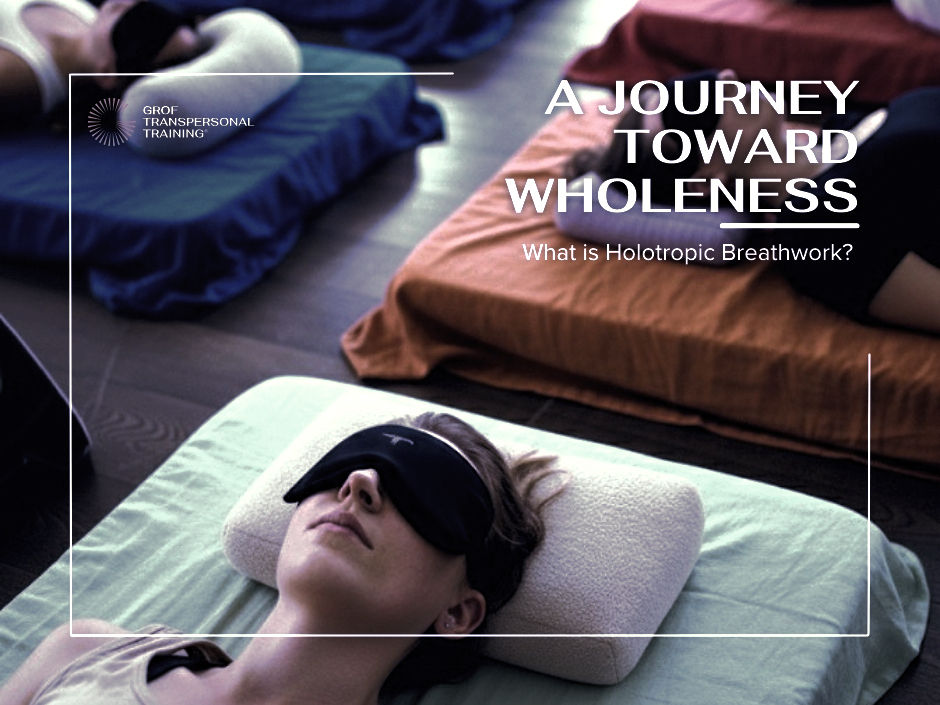
Holotropic Breathwork sessions take place in a carefully held group setting.
Participants work in pairs, alternating between two roles:
Breather – the person lying on a comfortable mat and entering the inner journey
Sitter – the partner who remains present and supportive throughout the process
The session typically begins with a guided relaxation. Participants then deepen their breathing for a short period, allowing the breath to open the doorway into an expanded state of consciousness.
From there, the process unfolds naturally, supported by a carefully designed sequence of music.
Most inner journeys last around three hours, although the exact duration varies for each person and is adapted to the individual process.
An experienced facilitation team remains present throughout the session to ensure safety and to offer support when needed.
Facilitators only intervene when asked for support or when a situation evolves that is not safe for the breather or any other participant.
Integration: Bringing the Experience Into Life
The breathwork session itself is only part of the process.
Equally important is integration, the unfolding of meaning after the experience.
Workshops typically include practices such as:
creative expression through mandala drawing
journaling or reflective writing
group sharing
embodiment and grounding exercises
These practices help participants translate their inner experiences into insights that can gradually become part of everyday life. At the end of each workshop an overview of possible tools for integration are given and possibilities for integration support are spelled out.
The Role of the Facilitation Team
The role of the facilitation team is to provide a safe space. Authentic Holotropic Breathwork is always held by trained facilitators who have completed a rigorous multi-year training program such as Grof Transpersonal Training®.
Facilitators are trained not only in the breathwork method itself but also in:
trauma-informed practice
body-oriented support methods such as Focused Energy Release
Another important indicator of a genuine workshop is team facilitation. Holotropic Breathwork is never conducted by a single leader alone. A trained team ensures that participants receive adequate support.
Typical ratios include:
about 4 facilitators for 20 participants
about 6 facilitators for 30 participants
even in smaller workshops with only 8 to 14 participants 2-3 facilitators are present
Signs of an Authentic Holotropic Breathwork Workshop
If you are considering participating in a workshop, a few simple questions can help you determine whether it follows the original method:
Are the facilitators certified through Grof Transpersonal Training® or another Grof® school?
Is there a screening process for contraindications?
Does the workshop include preparation, breathwork sessions, and integration?
Do participants work in breather–sitter pairs?
Is there a big enough team of facilitators, not just a single instructor?
Is the process supported by music and a carefully structured setting?
Does the music play during the session for around three hours?
Is the individual process allowed to unfold as long as it takes (shorter or longer than the music plays)?
Are sharing circles conducted without any cross-talk, questioning or interpretation?
Are integration tools provided and possibilites for integration support be spelled out?
If these elements are present, you are likely in a setting that honors the original approach developed by the Grofs.
A Space for Depth and Discovery
When held in this way, a Holotropic Breathwork workshop becomes much more than a breathing exercise.
It becomes a carefully held space where psychological exploration, emotional healing, and the mystery of consciousness can unfold together.
Participants often arrive with questions about their lives, their struggles, or their purpose.
What they discover is often something deeper: an encounter with the vast and creative intelligence of the psyche itself.
And sometimes, in the quiet after the music fades, people realize that the journey they began with a single breath has opened the doorway to a lifelong exploration of the inner world.